Lizzie Borden took an axe, and gave her mother 40 whacks. When she saw what she had done, she gave her father 41.
That schoolyard rhyme has been bouncing around American playgrounds since the 1890s, and with Ryan Murphy’s Monster: The Lizzie Borden Story landing on Netflix on September 17, 2026, a whole new generation is about to get acquainted with one of the most haunting unsolved murders in U.S. history. But before the prestige drama rewrites the legend – and Murphy always rewrites the legend – let’s separate the cold hard facts from the theatrical flourishes.
Starting with the question everyone ends up Googling: Where is Lizzie Borden actually buried? Let’s find the answer today.
Where is Lizzie Borden Buried? The Real Answer
Lizzie Borden died on June 1, 1927, in Fall River, Massachusetts – the same city where she had lived her entire 66 years and the same city that never quite forgave her. She died of pneumonia, acquitted but never truly free, shunned by polite society for the final three decades of her life.
Her resting place is Oak Grove Cemetery, a sprawling 100-acre rural garden cemetery at 765 Prospect Street in Fall River – about 1.5 miles from the infamous house on Second Street where her father and stepmother were butchered on August 4, 1892. The cemetery is the most significant in the city, established in 1855, and was designed by local architect Josiah Brown in the same pastoral tradition as Mount Auburn Cemetery in Cambridge.
What makes the grave unusual is its intimacy with the very people Lizzie was accused of killing. She is buried in the Borden family plot alongside her father Andrew, her stepmother Abby, and her biological mother, Sarah, who died when Lizzie was an infant. It’s one of true crime’s strangest ironies: whether she swung that hatchet or not, she ended up in the ground next to them for eternity.
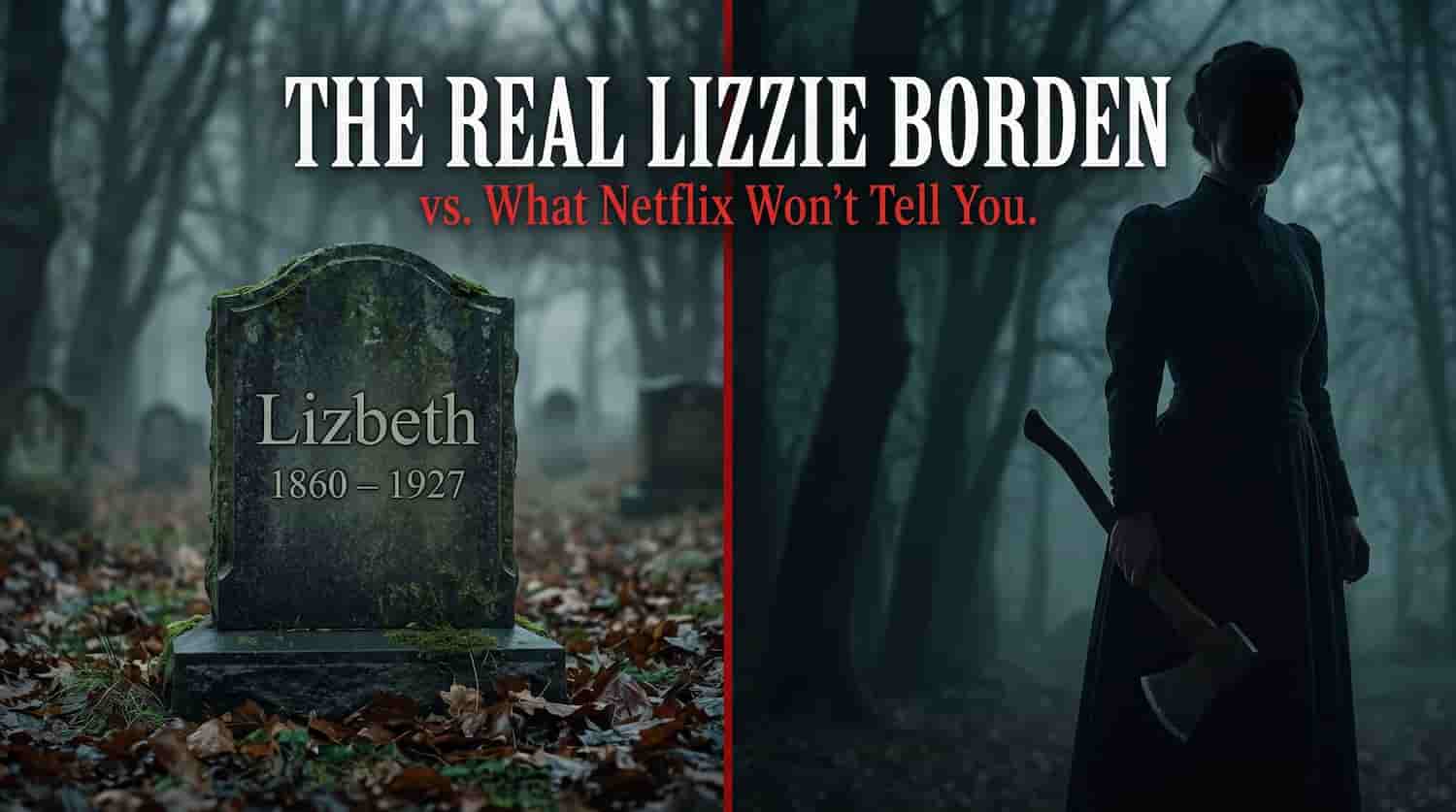
The plot features a large “Borden” monument – the kind of grand Victorian headstone that draws the eye, which marks the graves of Andrew, Abby, and Lizzie’s mother Sarah. Many first-time visitors assume it’s Lizzie’s stone. It isn’t. Lizzie’s own marker is a study in contrast: a small, modest slab, low to the ground, engraved simply with the name “Lizbeth” – the name she preferred to go by after her acquittal, when she reinvented herself in a new house in the upscale Highlands neighborhood of Fall River.
Her sister, Emma Borden, died just nine days after Lizzie, and was buried beside her. No one was invited to Lizzie’s funeral.
The grave is so heavily visited that the cemetery management has painted white arrows on the pavement to guide tourists from the main gate directly to the Borden plot. It has also been the target of vandalism – in April 2015, the grave was defaced with green and black paint, which the cemetery director noted was not the first incident.
How to visit: Enter the cemetery from the east end of Prospect Street, just after it crosses Stetson Street. Follow the painted arrows from the main entrance – the Borden graves are a short drive from the gate.
Related: Jesse Metcalfe Net Worth 2026: How much money does he have?
The Real Story: What Actually Happened on August 4, 1892
To understand why the grave matters, why people still make pilgrimages to a tiny stone in a Massachusetts cemetery – you have to understand the crime that made Lizzie Borden immortal.
The Murders
On the morning of August 4, 1892, the Borden household on Second Street, Fall River, was home to five people: Andrew Borden, his second wife Abby, their daughters Lizzie and Emma (though Emma was away visiting friends), and the live-in Irish maid, Bridget Sullivan. By midmorning, two of them were dead.
Abby Borden was found in the upstairs guest bedroom, having been struck 18 to 19 times with a sharp instrument from behind. Andrew Borden was discovered on the sitting room sofa, having returned from his morning errands and apparently lain down to rest. He had been struck 10 to 11 times. Both victims died from crushing blows to the head.
Lizzie claimed she had been in the barn when her father was killed, and that she discovered his body shortly after he came home. Bridget Sullivan said she was outside washing windows. The murders, medical examiners concluded, happened roughly an hour apart, meaning the killer had either hidden in the house between the two crimes or moved with calculated patience.
The Suspect and the Trial
Suspicion fell almost immediately on Lizzie. She was 32 years old, unmarried, a Sunday school teacher, and a member of the Women’s Christian Temperance Union, the last person anyone expected to be capable of such savagery. And that, some historians argue, is precisely why she walked free.
She was arrested on August 11, 1892, and formally indicted by a grand jury. Her trial held before three judges at the Bristol County Courthouse in New Bedford, Massachusetts. The trial began on June 5, 1893, and became a national sensation that eclipsed coverage of the Chicago World’s Fair.
The prosecution’s case was almost entirely circumstantial. No blood-soaked clothing was ever found, though Lizzie was known to have burned a dress days after the murders, claiming it was stained with paint. A hatchet handle-less and suspiciously cleaned was found in the basement. Testimony about Lizzie attempting to purchase prussic acid the day before the murders was excluded by the judges as inadmissible. Her own accounts of her whereabouts shifted and contradicted themselves throughout questioning.
Lizzie could also afford the best legal team in Massachusetts, including a former state governor whose appointment had placed one of the three presiding justices on the bench. That justice delivered what one major newspaper characterized as a charge to the jury that read more like a plea for acquittal.
After just 90 minutes of deliberation, an all-male jury found Lizzie Borden not guilty. The courtroom erupted in cheers. She walked out of court and said simply: “Please take me home. I wish to go home now.”
The case has never been solved. No one else was ever charged.
Related: Where is Scott Peterson Now? His Prison Sentence, Appeal and Latest Update
Life After Acquittal
Acquitted, but not free. Fall River never forgave her, and polite society made that clear from the moment she walked out of the courthouse. She moved into a large seven-bedroom house in the upscale Highlands district, which she named Maplecroft, with her sister Emma and came into her late father’s considerable fortune.
She embraced a new social circle — theater people, considered scandalously low-class in that era — and became particularly close to actress Nance O’Neill, a celebrated stage star often compared to Sarah Bernhardt. The close friendship, which some have speculated was romantic in nature, caused a rift with Emma that reportedly ended their relationship for good. Despite living under the same roof at Maplecroft for years, the two sisters reportedly stopped speaking entirely.
Lizzie Borden lived out the rest of her days in Fall River, shunned but wealthy, a ghost haunting her own life. She never gave a full public account of what she knew or didn’t know about the murders of August 4, 1892.
Monster Season 4: What Ryan Murphy Changes (And Why it matters)
Ryan Murphy has never made a secret of his approach to true crime: he uses documented facts as scaffolding, then builds something wilder and more provocative on top. Season 4 of Monster: The Lizzie Borden Story — dropping all eight episodes on September 17, 2026 — is no different. And if the trailers and pre-release interviews are anything to go by, Murphy is swinging harder than ever.
The Cast
Ella Beatty (daughter of Annette Bening and Warren Beatty, previously seen in Murphy’s Feud: Capote vs. The Swans) plays Lizzie. Charlie Hunnam, who terrified audiences as Ed Gein in Season 3, returns to the franchise as Andrew Borden, Lizzie’s father. Rebecca Hall (Christine, Passing) plays stepmother Abby Borden — teasing her performance as somewhere between Faye Dunaway in Mommie Dearest and Vivian Pickles in Harold and Maude. Vicky Krieps (Phantom Thread) plays maid Bridget Sullivan. Billie Lourd plays Emma Borden. Jessica Barden plays actress Nance O’Neill. And Sarah Paulson returns to the Murphy universe as none other than Aileen Wuornos, in scenes set decades later that explore the idea of Lizzie’s legacy inspiring future female killers.
This is the first season of the Monster anthology to center on a woman as the alleged perpetrator.
The Big Creative Gamble: Lizzie and Bridget
The most significant departure from historical record is the show’s central dramatic engine. The series leans heavily — and explicitly — into the theory that Lizzie Borden and maid Bridget Sullivan were engaged in a secret lesbian romance, and that this relationship motivated, or at least accompanied, the murders.
Netflix’s official logline describes it as “a twisted escape fantasy: a repressed daughter and the family maid, trapped in a house built on humiliation and cruelty, slip into a shared world of sex, power and revenge.” Cast descriptions refer to Bridget Sullivan’s character as Lizzie’s “renegade, punk-inspired Fairy Godmother and accomplice.”
This theory has circulated among Borden researchers and amateur sleuths for decades, and is not invented whole-cloth by Murphy. There is genuine speculation in the historical record about the nature of Lizzie’s relationships and her attraction to actresses and bohemian circles. But there is no documented evidence of a romantic or sexual relationship between Lizzie and Bridget Sullivan, and Bridget herself emigrated back to Ireland after the trial and never publicly spoke about Lizzie in those terms.
Murphy is taking historical speculation and dramatizing it as lived experience — which is very much the Monster franchise’s operating mode, and also why descendants and historians have previously objected to the show’s methods.
The “Female Rage” Framework
The season is being pitched by its creators as an exploration of female rage and Victorian repression — what it meant to be a woman trapped in a patriarchal household in 1890s New England with no legal rights, no financial independence outside of inheritance, and no exit. Ella Beatty has said the season examines “female rage and repression which I’ve found to feel strikingly relevant.”
This framing positions Lizzie not as a monster in the traditional sense, but as a product of suffocating social conditions — a woman who may have had no other way out. It’s a perspective with genuine historical weight: Lizzie’s tensions with her father Andrew were partly rooted in his iron control of the family’s finances, his refusal to modernize the house (no electricity, no running water in an era when they could absolutely afford it), and his transference of wealth to Abby’s family members, which Lizzie and Emma resented deeply.
Whether that constitutes a motive for murder is precisely the argument the series intends to make — and leave unresolved.
The Aileen Wuornos Connection: Pure Murphy
The subplot involving Sarah Paulson as Aileen Wuornos — the Florida serial killer executed in 2002 — is the most clearly invented element of the season. Murphy and co-creator Ian Brennan have confirmed that the show will feature cameo appearances from other famous female killers throughout history, framing them as a lineage inspired by Lizzie’s legacy.
There is no historical, factual, or documented connection between Lizzie Borden and Aileen Wuornos. This is Murphy doing what Murphy does: using true crime as a canvas to paint a larger, more mythological narrative about women, violence, and American culture. Your mileage may vary, but nobody should walk away from Season 4 thinking Aileen Wuornos ever heard of Lizzie Borden in any meaningful sense.
The Needle Drops
Because it’s Ryan Murphy, the show is reportedly using modern needle drops. Artists like Kate Bush and Wet Leg over its Victorian-set scenes, this is a deliberate anachronism designed to underline the emotional universality of the story rather than its period specificity. Love it or loathe it, it’s a signature Murphy move.
Real vs. Reel: A Quick Breakdown
| Element | Real History | Monster Season 4 |
| Lizzie’s guilt | Never proven; acquitted 1893 | Strongly implied; portrayed as guilty |
| Bridget Sullivan’s role | Maid; gave testimony; emigrated after trial | Central character; depicted as romantic partner and co-conspirator |
| Motive | Financial tensions, family conflict | Lesbian romance + escape from abuse |
| Andrew Borden | Wealthy, frugal, largely disliked | Portrayed as cruel and abusive |
| Abby Borden | Stepmother; relationship with Lizzie was strained | Portrayed as villainous |
| Aileen Wuornos connection | None | Invented to explore Lizzie’s cultural legacy |
| Lizzie’s death & burial | Died June 1, 1927; Oak Grove Cemetery, Fall River | Not confirmed as depicted in the show |
| Musical score | N/A | Modern needle drops (Kate Bush, Wet Leg) |
Why the grave matters more than the show?
Every true crime story eventually comes down to a body, or in Lizzie’s case, to the absence of a clear answer and the presence of a quiet headstone that just says “Lizbeth.”
The grave at Oak Grove Cemetery is genuinely eerie not because of ghost tour mythology, but because of what it represents: a woman who was tried, acquitted, and then condemned anyway, not by law, but by the whisper economy of a Victorian mill town. She outlived most of her accusers. She outlived her sister by nine days. She left the world without ever confessing or being definitively cleared.
Ryan Murphy will give you a version of Lizzie that is cinematic, sensational, and emotionally potent. It will probably be riveting television. Ella Beatty will likely be brilliant. But the true Lizzie Borden, the one who chose the name “Lizbeth,” who bought a mansion and filled it with actress friends, who burned a dress one morning in August 1892 and took the answer with her, rests beneath a small stone in Fall River, Massachusetts.
The arrows on the road will take you right to her.
Visit Information
Oak Grove Cemetery 765 Prospect Street, Fall River, MA 02720 Coordinates: 41.707660, -71.138272 Hours: Monday–Friday, 7am–3pm (gated after hours)
Enter from the east end of Prospect Street, just past Stetson Street. Follow the white painted arrows from the main gate to the Borden family plot. The famous small “Lizbeth” stone is to the right of the large Borden monument.
Lizzie Borden House & Museum (B&B) 230 Second Street, Fall River, MA (1.5 miles from Oak Grove) The site of the 1892 murders, now operating as a bed and breakfast with museum tours and ghost tours.
Monster: The Lizzie Borden Story premieres September 17, 2026 on Netflix with all eight episodes dropping at once.

- Where to watch Carrie TV Series (2026): Streaming Guide, Episodes and Everything You Need to Know - October 14, 2026
- Verity: Where to Watch, Streaming Release, Cast and Reviews - October 11, 2026
- How to watch General Conference 2026 on YouTube, TV & More - October 4, 2026