
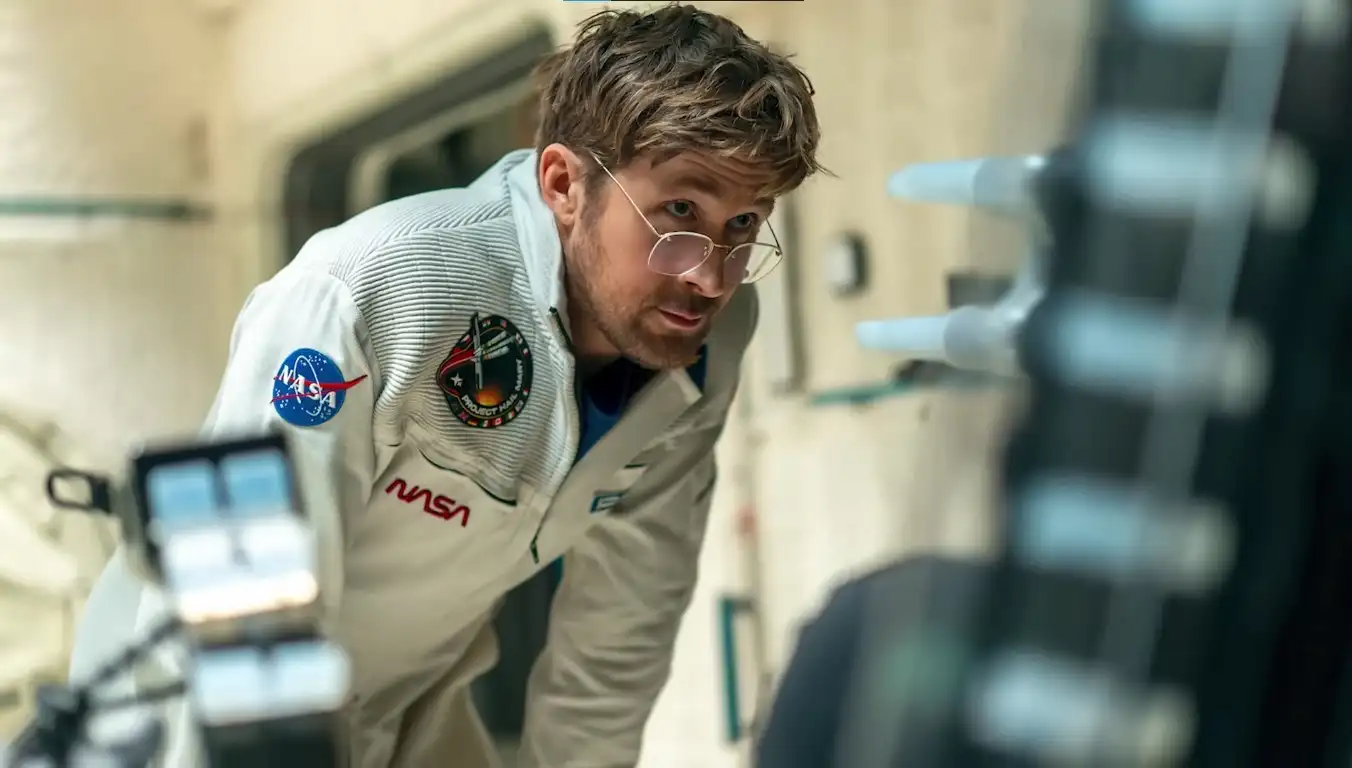
There are plenty of reasons Project Hail Mary feels different from the usual big-budget space movie.
Ryan Gosling is carrying a huge part of the movie almost by himself. Rocky is one of the strangest, and somehow most lovable movie characters in recent sci-fi. And the Hail Mary itself feels less like a shiny Hollywood spaceship and more like a machine that someone actually built, climbed inside and somehow launched into space.
Turns out, that feeling was very much intentional.
Director Christopher Miller revealed that not a single green or blue screen was used while filming the movie. The filmmakers actually built the interior of the Hail Mary as a physical set, along with a large section of its exterior.
And honestly? Once you know that, a lot of the movie suddenly makes more sense.
They actually built the Hail Mary
Think about what most modern sci-fi productions could have done.
Put Ryan Gosling inside a partial spaceship set.
Paint everything else green.
Add the walls, windows, machinery and space around him later.
It would have been faster in some ways. But Project Hail Mary went in a different direction.
Miller said the entire interior of the Hail Mary was built as a set. The production also constructed a huge section of the ship’s exterior.
That matters because Gosling wasn’t acting inside an empty box while imagining the spaceship around him.
He was actually inside the spaceship.
The walls were there.
The equipment was there.
The lights were there.
And, perhaps most importantly, Rocky was there.
That gave the actors and camera crew something real to work with instead of asking everyone to imagine what would eventually be added in post-production.
And yes, Rocky was actually there too
This might be the coolest part.
Rocky isn’t the kind of character you can simply throw an actor in front of a green screen and call it a day.
He’s an alien spider-like rock creature with multiple limbs, a completely different way of communicating and a personality that somehow has to come through despite the fact that you’re basically looking at a giant alien rock.
So the filmmakers used a practical Rocky on set.
Miller explained that Rocky was physically present during filming, allowing Gosling to actually react to him. The character was ultimately created through a blend of puppetry and animation, with Framestore handling the digital side.
That makes a huge difference.
Instead of Ryan looking at a piece of tape on a wall and pretending his best friend is standing there, there was something in front of him that he could actually see and respond to.
And that probably helps explain why the Grace-Rocky relationship feels so natural.
You can feel the actors reacting to each other.
But wait… doesn’t Project Hail Mary have VFX?
Absolutely.
This is where the “no green screen” story can get confusing.
No green screen does NOT mean no visual effects.
Miller actually had to clarify this after his comments started spreading online.
According to the director, the movie contains 2,018 VFX shots. Those include digital work on the ship, space environments and Rocky, among many other things.
So let’s kill the misconception right here:
Project Hail Mary is absolutely a VFX movie.
It just didn’t use traditional green or blue screens as the foundation for its live-action photography.
And that distinction is important.
So what did they use instead?
This is where the filmmaking gets really interesting.
When Gosling was outside the ship, the filmmakers didn’t simply surround him with a giant green wall.
They used different backgrounds depending on what was supposed to be around him.
For shots involving deep space, they used a black background.
For shots involving the colorful light of a planet or aurora, they used a shifting background that could actually put the right color onto Gosling’s face and body while filming.
Why go through all that trouble?
Because light matters.
A green screen can create green spill on an actor. That can affect the way the skin, costume and other surfaces look on camera. Cinematographer Greig Fraser explained that this can create problems when filmmakers later try to replace the background with something completely different.
Instead, the Project Hail Mary team wanted the light hitting Gosling to already feel like it belonged in the scene.
If he’s standing next to a glowing alien world, they wanted that strange light to actually be hitting him.
Not something that would be digitally recreated later.
That’s a small difference that can make a huge difference on screen.
RELATED: The Whisper Man is #1 in 68 Countries – Here’s How to watch it right now
The Hail Mary was supposed to feel messy
And this might be the secret sauce behind the movie’s look.
Phil Lord and Christopher Miller didn’t want the Hail Mary to look like a perfect futuristic showroom.
They wanted it to feel lived-in.
The directors talked about looking at the International Space Station and noticing how messy real spacecraft can be wires, equipment, clutter and machinery everywhere.
Basically, they didn’t want the Hail Mary to look like an Apple Store in space.
They wanted it to look like a machine with its guts showing.
That’s why the ship has so much texture.
It’s not perfectly clean.
It’s not perfectly organized.
It feels like different people built different pieces of it.
And that was deliberate.
Lord described the ship as almost like a quilt made by different nations, with different rooms reflecting the people who built them. The filmmakers also drew inspiration from Alien, particularly its dirty, tactile production design.
That approach makes the Hail Mary feel like somewhere you could actually live.
Or, more accurately…
somewhere you could actually get stuck.
It also changed the way the movie was shot
Here’s another detail fans may appreciate.
Because the sets were really there, Greig Fraser had much more freedom with the camera.
The directors wanted the movie to feel immediate and natural instead of overly polished.
And because Rocky was physically present, Fraser could move the camera around and find reactions between Gosling and Rocky organically. Miller specifically pointed to the practical sets and Rocky as major reasons the movie could capture those unexpected moments.
That’s a big deal for a movie where one of the most important relationships is between a human and an alien.
You don’t want every shot to feel like:
“Okay, Ryan, pretend the alien is over there.”
You want Ryan to look at something.
You want him to react.
You want the camera operator to see that reaction and move with it.
That’s the kind of filmmaking that can make a scene feel discovered rather than manufactured.
RELATED: Where is Lizzie Borden buried? Real story vs Monster Season 4
But the space shots? Those are still digital
Of course, nobody actually built a giant spaceship and flew it across the galaxy.
The wide exterior space shots were created digitally, with ILM handling the large-scale spaceship and space imagery.
And that’s exactly how this kind of movie should work.
Build what the actors need.
Use practical lighting where it helps.
Give the camera real objects to photograph.
Then let visual effects artists take over when you’re showing things that would be completely impossible to film for real.
It’s not practical effects vs. CGI.
It’s knowing when each one works best.

And suddenly, Rocky makes even more sense
The coolest thing about all of this isn’t actually the spaceship.
It’s the friendship.
Project Hail Mary needs you to believe that Ryland Grace and Rocky genuinely become friends.
That’s a surprisingly difficult thing to pull off.
Rocky doesn’t have a human face.
He doesn’t communicate like a human.
He doesn’t even look remotely human.
Yet somehow, you’re supposed to care about this alien.
A lot.
The filmmakers knew this was one of the biggest challenges of adapting Andy Weir’s novel. Lord said the audience eventually needs to reach the point where they feel like they would die for that rock.
And that’s why having Rocky physically present on set was such a smart choice.
Gosling wasn’t just reacting to a future visual effect.
He had something tangible in front of him.
Something that could move.
Something the camera could follow.
Something he could actually play off.
Then the visual-effects artists took that performance and carried it into the finished Rocky.
It’s a collaboration between practical filmmaking and digital artistry – not one replacing the other.
So, no green screen doesn’t mean “no movie magic”
If anything, it shows just how much work went into making the movie feel real.
Project Hail Mary still has thousands of visual-effects shots. It still has massive digital space environments. It still has a completely digital-looking universe surrounding the Hail Mary.
But the filmmakers didn’t want the actors to spend the entire production pretending they were standing inside those worlds.
They built the parts that mattered.
They lit them.
They filled them with physical details.
They put Rocky in the room.
And then they used VFX to finish the impossible parts.
That’s probably why the movie has such a tactile feeling.
You’re watching a digital space adventure that was grounded in a surprisingly physical production.
And once you know that, the Hail Mary doesn’t just look like a spaceship anymore.
It feels like one.
And honestly, for a movie about one man being sent millions of miles away from home with an alien rock as his only real friend…
that’s exactly what it needed to feel like.

- Where to watch Carrie TV Series (2026): Streaming Guide, Episodes and Everything You Need to Know - October 14, 2026
- Verity: Where to Watch, Streaming Release, Cast and Reviews - October 11, 2026
- How to watch General Conference 2026 on YouTube, TV & More - October 4, 2026