
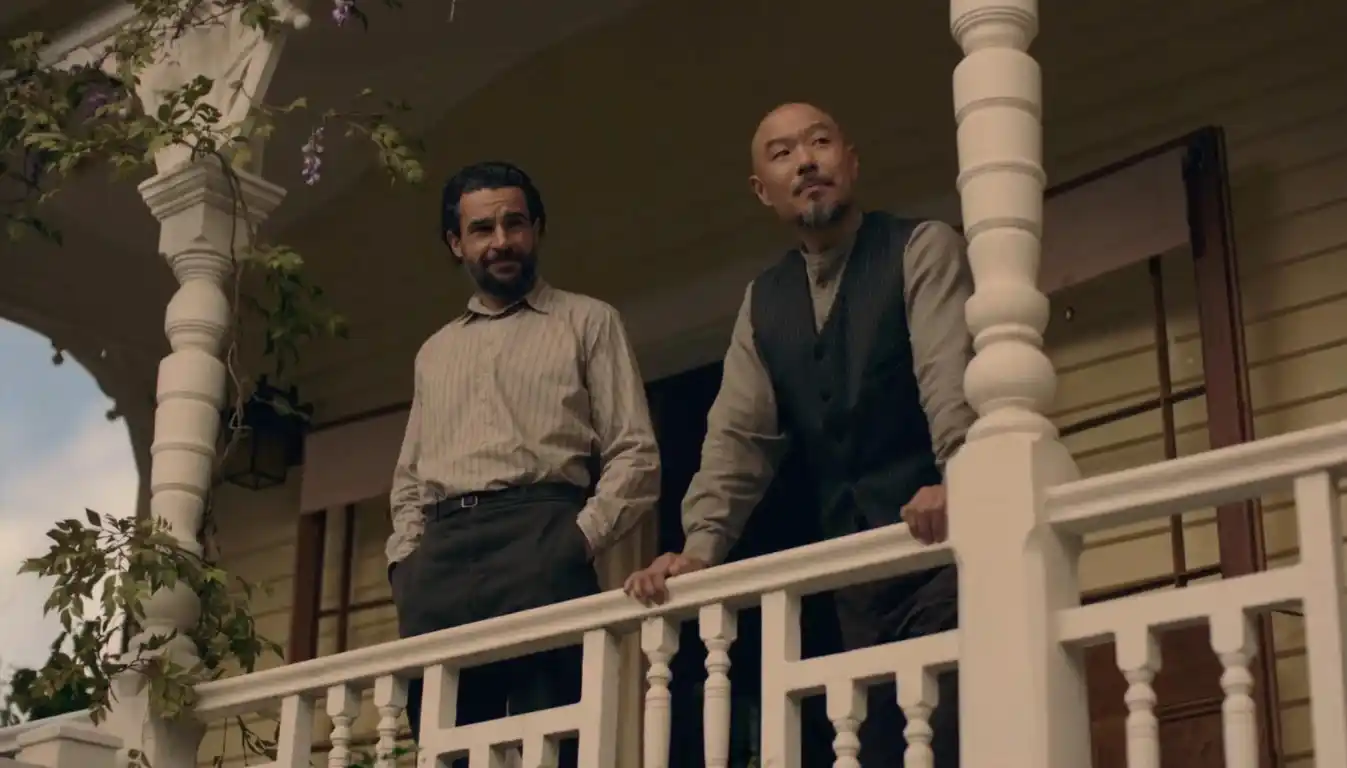
John Steinbeck’s East of Eden has been brought to the screen twice, more than seven decades apart, and the two adaptations took very different approaches to recreating his California.
Elia Kazan’s iconic 1955 film starring James Dean was filmed across California, including the Salinas Valley, Monterey, Mendocino and Warner Bros. Studios in Burbank. The new 2026 Netflix limited series, starring Florence Pugh, Christopher Abbott and Mike Faist, went in the opposite direction, using New Zealand to recreate early-20th-century California.
So where was East of Eden filmed? Here’s a look at the real locations behind both adaptations, when each production filmed, and how filmmakers recreated Steinbeck’s world more than 6,000 miles from California.
Where was the 2026 East of Eden series filmed?
The 2026 Netflix series was filmed extensively in New Zealand, rather than California. Netflix says the production moved more than 6,000 miles away from the Salinas Valley because modern-day California no longer looked like the landscape Steinbeck described, while New Zealand offered period architecture and relatively untouched landscapes.
East of Eden 2026 filming locations
| Location | What it represented |
|---|---|
| Ōamaru, New Zealand | Town/period California locations |
| Dunedin, New Zealand | California town and street locations |
| Otago / Central Otago | Rural and agricultural landscapes |
| Auckland | Interior/set work |
| Thames | Additional location filming |
The New Zealand Film Commission confirms the series was filmed extensively across New Zealand, while production-location records identify Dunedin, Ōamaru, Auckland and Thames.
| Content | 1955 Film | 2026 Netflix Series |
|---|---|---|
| Director | Elia Kazan | Garth Davis / Laure de Clermont-Tonnerre |
| Lead | James Dean | Florence Pugh |
| Main filming country | California | 🇳🇿 New Zealand |
| Key location | Salinas Valley | Otago / Ōamaru |
| Filming | May 1954 onward | October 2024–2025 |
| Format | Feature film | 7-episode limited series |
The 2026 series is also not simply a remake of the 1955 movie. Zoe Kazan’s adaptation covers much more of Steinbeck’s novel and centers Cathy Ames, played by Florence Pugh.
East of Eden (1955) Filming Locations
East of Eden was filmed primarily in California, using a combination of real locations and studio sets. The production shot scenes in Mendocino, the Salinas Valley, Monterey and Humboldt County, while Warner Bros. Studios in Burbank handled important interior and backlot sequences. Principal photography began in May 1954, with location work continuing through May and June before the film was completed for its 1955 release.
Warner Bros. Studios, Burbank, California
Location: 4000 Warner Blvd, Burbank, CA 91505

The Trask family house. You know, the one where Cal (James Dean) lives with his stern father Adam and his favored brother Aron? That wasn’t a real house. It was a set. A carefully constructed set at Warner Bros. Studios in Southern California.
Director Elia Kazan spent significant time working on these interior sets. The studio backlot became the creative hub of production. The parade scenes? Also filmed here at Warner Bros. They used the town square on Midwest Street. The architectural details in the background are still recognizable today.
This church on the Warner backlot appears during the parade sequence. It’s become one of the most recognizable structures in classic Hollywood cinema. The versatile set has hosted countless productions over the decades.
RELATED: Where was The Love Hypothesis filmed? All Filming Locations Revealed
Other Notable Productions at Warner Bros. Studios Backlot
| Film/TV Show | Year | Details |
|---|---|---|
| The Lost Boys | 1987 | Church featured prominently |
| The Monster Squad | 1987 | Church appeared in scenes |
| Gremlins | 1984 | Backlot locations used |
| Batman: The Movie | 1966 | Major filming location |
| Lethal Weapon 2 | 1989 | Action sequences filmed here |
| The Beverly Hillbillies (TV) | 1960s | Weekly television production |
| Wonder Woman (TV) | 1970s | Combat scenes and exteriors |
| The Munsters (TV) | 1960s | Regular production venue |
| Charlie’s Angels | 1970s | Stunt sequences filmed here |
The backlot itself is like a time capsule. It’s survived earthquakes. It’s survived changing production trends. The legendary church remains one of the most utilized sets in cinema history.
Mendocino, California – The Northern Gem
Location: Mendocino, California (approximately 257 miles north of Salinas)
Here’s something interesting. While the film is set in Salinas and Monterey, much of the actual location work happened in Mendocino. This small Northern California town offered something special. Authentic period architecture. Genuine agricultural landscapes. The kind of settings that make a film feel lived-in and real.
Kazan wasn’t just looking for any small town. He needed one with character. Mendocino delivered. The Victorian architecture. The rugged coastal landscape. These elements became visual shorthand for the Salinas Valley farming community in the film.
The production crew spent considerable time here in May and June of 1954. This was during principal photography. They captured the essence of rural California. The scenes they filmed here ground the narrative in authentic geography.
Mendocino’s Film Legacy
| Production | Year | Type | Notes |
|---|---|---|---|
| East of Eden | 1955 | Feature Film | Major location work |
| Madam Secretary (TV) | Various | Television Series | Multiple episodes filmed |
| Big River | 1984 | Feature Film | Period drama production |
| Murder, She Wrote (TV) | 1980s-1990s | Television Series | Regular filming location |
| Inception | 2010 | Feature Film | Dream sequence locations |
| Dreamland | 2019 | Feature Film | Desert town double |
Mendocino has become a popular stand-in for various time periods and locations. Its architecture is too distinctive to ignore. Film producers continue to recognize its value as a location.
Salinas Valley, California – The Agricultural Heart
Location: Salinas Valley, Central California
The Salinas Valley is more than just a location. It’s the soul of East of Eden. The valley itself is a character in the story. John Steinbeck was born in Salinas in 1902. He knew these lands intimately. His novel reflected that deep knowledge.
Kazan understood something crucial. He needed to capture real farming life. The lettuce fields. The agricultural machinery. The relationship between farmers and land. You can’t fake that in a studio.
The production traveled to the Salinas area. They coordinated with local farmers. Kazan famously timed the bean field scene to coincide with real crop growth. He wanted the field to be exactly three feet tall for specific shots. That’s the level of detail he pursued.
The opening title card reads: “In Northern California, the Santa Lucia Mountains, dark and brooding, stand like a wall between the peaceful agricultural town of Salinas and the rough and tumble fishing port of Monterey, fifteen miles away.” Those mountains? The geography? It’s all real. Filmed on location.
RELATED: Where was A24’s Primetime filmed? Robert Pattinson’s Movie Locations
The Valley’s Agricultural Heritage in Cinema
| Production | Year | Crop Focus | Details |
|---|---|---|---|
| East of Eden | 1955 | Lettuce/Beans | Coordinated real farming |
| Steinbeck Country documentaries | Various | Various | Educational films |
| Monterey County Films | Multiple | Agriculture | Regional productions |
| American agricultural documentaries | 1950s-1960s | Multiple | Educational productions |
The valley continues to be documented in film. Its agricultural significance makes it valuable for authentic period pieces. The landscape hasn’t changed dramatically, making it ideal for period filmmaking.
Monterey, California – The Fishing Port
Location: Monterey, California (approximately 15 miles from Salinas)
Monterey represents something different. It’s where Cal discovers a troubling family secret. His supposedly dead mother, Kate, operates a brothel in Monterey. Cal visits her there. The contrast between Salinas and Monterey reflects the contrast between innocence and harsh reality.
Monterey’s working fishing port aesthetic served the production well. The coastal atmosphere. The pier. The industrial fishing structures. All of it communicated a certain roughness absent from the agricultural valley.
Scenes in Monterey were filmed on location. The cinematography captures real coastal California. The salty air seems to come through the screen. The authenticity matters because it’s where the family’s comfortable narrative unravels.
Monterey’s Film History and Location Production
| Production | Year | Type | Setting |
|---|---|---|---|
| East of Eden | 1955 | Drama | Harbor/Port scenes |
| Cannery Row | 1986 | Feature Film | Harbor-based adaptation |
| Other Monterey Productions | Various | Multiple | Coastal California setting |
| Tourist and promotional films | Various | Documentary | Regional promotion |
Monterey has been featured in numerous productions. Its natural beauty and authentic working harbor make it valuable for filmmakers. The location brings credibility to stories set in central California.
The Humboldt County, Northern California
Location: Humboldt County, Northern California
Beyond the main locations, production also extended into Humboldt County. This northernmost region of coastal California added additional depth to location work.
The county’s landscapes provided alternative agricultural and coastal visuals. The production team wanted to capture a comprehensive view of Northern California’s geography.
Limited information exists about specific Humboldt County scenes. The archive records confirm filming occurred there during principal photography. The county’s contribution remains part of the film’s authentic California tapestry.
East of Eden Cast
James Dean as Cal Trask
James Dean stars as Cal, a young man seeking the love and acceptance of his father, Adam. This was his first major starring role. He had risen from supporting roles on television to stardom in East of Eden.
This was James Dean’s first starring role after a string of supporting roles on television, and he would complete two more movies (Rebel Without a Cause and Giant) before his untimely death in 1955. Tragically, East of Eden would be the only film he made at Warner Bros. released while he was still alive.
The role became iconic. Critics compared him to Marlon Brando. His intensity. His naturalistic acting style. His emotional vulnerability. All of it revolutionized how young actors approached dramatic roles.
Other Cast Members
| Actor | Character | Role Significance | Career Impact |
|---|---|---|---|
| Raymond Massey | Adam Trask | Father figure | Established performer |
| Julie Harris | Abra Bacon | Love interest | Broadway-trained actress |
| Richard Davalos | Aron Trask | Twin brother | Feature film debut |
| Jo Van Fleet | Kate Trask | Mother character | Best Supporting Actress Oscar winner |
| Burl Ives | Sam the Sheriff | Supporting role | Accomplished character actor |
| Albert Dekker | Will Hamilton | Supporting role | Experienced performer |
| Lois Smith | Anne | Supporting role | Early career role |
East of Eden marked the film debuts of Richard Davalos and Jo Van Fleet, and the first major film role for Dean, who, in reviews, was compared to Actors’ Studio graduate Marlon Brando.
Julie Harris brought stage expertise to her role. She had significant Broadway experience. Harris found Kazan easy to work with and very stimulating.
Jo Van Fleet won the Academy Award for Best Supporting Actress. This was her film debut. That’s remarkable. An Oscar for your first film performance.
RELATED: Where is Murder in a Small Town Filmed? Real Locations Revealed
Behind the Scenes: Creating the Vision
Director Elia Kazan’s Approach
Elia Kazan directed with intensity. He had specific artistic goals. He wanted certain emotional responses from his actors.
Before shooting began on East of Eden, Kazan sent Dean off to Palm Springs to gain some weight and get some sun so that he looked like a “real” farm boy. This attention to detail extended throughout production.
Dean’s wild behavior and late night carousing worried Kazan. The director used this energy in a creative way. He wanted heightened conflict between father and son. He wanted genuine emotional outbursts.
Kazan overcame his reluctance by getting the actor drunk. This is shocking by modern standards. But it reflects how seriously Kazan pursued authentic emotional performances. Before the outburst, Kazan was able to capture the heightened anger he was going for.
Cinematography and Visual Storytelling
The film was shot on 35mm color film. This was significant for 1955. Color cinematography was still relatively new. Kazan had specific ideas about how to use color.
Kazan also strove to achieve dramatic effects with color, particularly by emphasizing green throughout. Green represented agricultural abundance. It represented life and growth. It became a recurring visual motif.
Kazan was proud of his use of CinemaScope to get what he thought was the best shot in East of Eden, the train pulling away with all the lettuce on it. This demonstrates his technical sophistication. He understood how new technologies could enhance storytelling.
Production Timeline and Coordination
| Phase | Timeline | Focus | Details |
|---|---|---|---|
| Pre-production | Early 1954 | Casting & preparation | Actor training in Palm Springs |
| Location scouting | May 1954 | Site selection | Mendocino, Salinas, Monterey |
| Principal photography | May-June 1954 | Filming production | Agricultural coordination |
| Studio work | May-August 1954 | Interior sequences | Warner Bros. backlot |
| Post-production | Late 1954 | Editing & music | Final assembly |
Principal photography on East of Eden began in May 1954. The production schedule was compressed. Kazan worked efficiently.
Kazan had to coordinate the filming of the bean field scene with a local farmer so that the crop would be exactly three feet tall for specific shots. This logistical challenge required precise timing. It demonstrates the production’s commitment to authenticity.
Relationship with John Steinbeck
John Steinbeck didn’t visit the set during production. Steinbeck stayed away from the set during production. His son Tom has said that Steinbeck felt it was Elia Kazan’s movie and not his and that he didn’t want to be an intimidating factor to the director and cast.
Despite this distance, Elia Kazan had become friends with John Steinbeck in 1952 while they worked closely together on the screenplay for Kazan’s “Viva Zapata”, starring Marlon Brando. They had an established relationship.
During production of “East of Eden”, Kazan wrote letters to Steinbeck to keep him informed about the film’s progress. This maintained their creative connection even from a distance.
Where to watch East of Eden?
The 2026 mini TV series is currently streaming on Netflix while the 1955 film is available on multiple platforms.
Digital Streaming and Purchase Options
| Platform | Availability | Format | Quality | Notes |
|---|---|---|---|---|
| Apple TV | Available | Rent/Purchase | 4K with Dolby Vision | Includes audio commentary |
| Amazon Prime Video | Available | Rent/Purchase | HD/4K varies | Multiple edition options |
| Google Play | Available | Rent/Purchase | HD/4K varies | Movies Anywhere compatible |
| Movies Anywhere | Available | Purchase | 4K Dolby Vision/Atmos | Digital code redemption |
| Vudu | Available | Rent/Purchase | Dolby Vision/HDR10 | Dolby Digital Plus 5.1 |
| Criterion Channel | Check availability | Streaming | Restored transfer | Specialty collection |
| HBO Max | Check availability | Streaming | Varies by region | Subscription-dependent |
The 4K restoration is significant. East of Eden has probably never looked or sounded better, according to home theater reviewers.
Physical Media Options
Want a tangible copy? Physical media remains available.
| Format | Availability | Retailers | Special Features |
|---|---|---|---|
| Blu-ray | Available | Amazon, Best Buy, specialty retailers | Commentary, documentaries |
| 4K Ultra HD Blu-ray | Available | Premium retailers | Enhanced picture/sound, extras |
| DVD | Available | Various retailers | Standard definition, basic extras |
The 4K restoration comes with a digital copy. You get both physical and digital ownership.
Bonus Content Available
The 2024 4K release includes valuable behind-the-scenes material.
| Extra | Runtime | Format | Platform Availability |
|---|---|---|---|
| “East of Eden: Art in Search of Life” | 19:29 min | Documentary featurette | Apple TV, Movies Anywhere |
| James Dean Screen Tests | 6:19 min | Bonus content | Digital redemption |
| Wardrobe Tests | 22:15 min | Production footage | Apple TV, Movies Anywhere |
| 1955 NYC Premiere Footage | 14:40 min | Historical document | Digital platforms |
| Deleted Scenes | 19:10 min | Alternate footage | Apple TV, Movies Anywhere |
| Theatrical Trailer | 2:45 min | Original promotion | Multiple platforms |
| Audio Commentary | Full runtime | Director analysis | Apple TV, Movies Anywhere |
RELATED: Where was Netflix’s ‘The Perfect Lie’ Filmed? Every Dutch Location Explained
Critical Reception and Reviews
Critical Acclaim
Bosley Crowther of NYT named East of Eden one of the top twenty films of the 1955. This wasn’t casual praise. The New York Times recognized the film’s significance immediately.
East of Eden was also a winner at the Cannes Film Festival and, according to an Aug 1955 HR news item, was shown at the Edinburgh Film Festival. International recognition followed quickly.
The film received multiple Oscar nominations. East of Eden was also nominated for Kazan’s direction and Paul Osborn’s screenplay, but lost in both categories to Marty’s Delbert Mann and Paddy Chayefsky, respectively. However, East of Eden won the Oscar for Best Supporting Actress (Jo Van Fleet).
Ratings Summary
| Rating Source | Score | Assessment | Significance |
|---|---|---|---|
| IMDb | 7.8/10 | Strong positive | 51,000+ user votes |
| Rotten Tomatoes | 86% Critics | Certified Fresh | Critical consensus strong |
| Metacritic | 72/100 | Favorable reviews | Professional critics average |
| The New York Times | Praised | Top 20 of 1955 | Contemporary critical recognition |
| Variety | “Raw and emotionally charged” | Positive contemporary review | Industry publication |
| FilmAffinity | 7.6/10 | Strong positive | Serious film enthusiasts |
4 Stars James Dean’s Oscar-nominated performance is how modern reviewers rate it. The performance remains the film’s greatest strength.
What Critics Praised
| Aspect | Critical Opinion | Details |
|---|---|---|
| James Dean’s Performance | Exceptional breakthrough | First major role, Oscar nomination |
| Emotional Depth | Powerful and authentic | Genuine family drama |
| Cinematography | Visually impressive | Masterful use of CinemaScope and color |
| Direction | Masterful | Elia Kazan’s artistic vision |
| Supporting Cast | Excellent | Jo Van Fleet’s Oscar win validated |
| Adaptation | Mostly faithful | Focus on final section of novel |
| Themes | Timeless | Cain/Abel retelling remains relevant |
What some critics found challenging?
A few critics noted the film’s pacing. Some felt it occasionally moved slowly. Melodramatic elements weren’t everyone’s preference. But even critical observations came with overall positive assessments.
The consensus is clear. East of Eden is a legitimate classic. Its reputation has only grown with time.
The Film’s Legacy and Cultural Impact
Awards and Recognition
| Award | Category | Recipient | Result |
|---|---|---|---|
| Academy Awards 1955 | Best Supporting Actress | Jo Van Fleet | Won |
| Academy Awards 1955 | Best Director | Elia Kazan | Nominated |
| Academy Awards 1955 | Best Screenplay | Paul Osborn | Nominated |
| Golden Globe 1955 | Best Motion Picture – Drama | East of Eden | Nominated |
| BAFTA Awards 1955 | Best Film | East of Eden | Nominated |
| BAFTA Awards 1955 | Best Actress | Julie Harris (as “Foreign Actress”) | Nominated |
| Cannes Film Festival 1955 | Palme d’Or | East of Eden | Nominated |
| Directors Guild America 1955 | Outstanding Directing | Elia Kazan | Nominated |
| Writers Guild America 1955 | Best Drama Screenplay | Paul Osborn | Nominated |
American Film Institute Recognition
East of Eden, along with Dean’s other films Rebel Without a Cause (1955) and Giant (1956), was named one of the 400 best American films of all time by the American Film Institute.
This is significant recognition. The AFI list represents the most prestigious films in cinema history. Being included places East of Eden in rarefied company.
James Dean’s Filmography Connection
James Dean completed exactly three films before his tragic death.
| Film | Year | Role | Status |
|---|---|---|---|
| East of Eden | 1955 | Cal Trask | Released while Dean was alive |
| Rebel Without a Cause | 1955 | Jim Stark | Released after death (Sept 30, 1955) |
| Giant | 1956 | Jett Rink | Released posthumously |
James Dean made one more film after this – “Giant,” which came out in October 1956. 30, 1955. He had just finished filming for “Giant.” That was just five months after “East of Eden” hit theaters. It’s interesting to note that the site of Dean’s accident was a few miles east of Paso Robles, California. That’s at the southern end of the Salinas Valley of Steinbeck’s “East of Eden.”
The tragic irony isn’t lost on cinema historians. Dean died just miles from the valley depicted in his breakthrough film.
Filming Location Visitor Information
Visiting the Filming Locations
If you want to visit the real locations where East of Eden was filmed, here’s practical information.
Warner Bros. Studios, Burbank
- Status: Working studio, limited access
- Tours: Public backlot tours available with advance booking
- Note: Many original sets have been modified or removed over decades
- Contact: Warner Bros. Studio Tour Hollywood official website
Salinas Valley
- Status: Active agricultural region
- Access: Public highways and county roads provide viewing areas
- Best viewing: Spring and early summer when crops are growing
- Note: Private property – view from public roads only
Mendocino
- Status: Historic town, fully accessible to public
- Attractions: Victorian architecture, coastal views
- Tourism: Well-established visitor infrastructure
- Note: Walking tours of town center capture period atmosphere
Monterey
- Status: Coastal city, fully accessible to public
- Attractions: Working harbor, museums, restaurants
- Tourism: Major California destination
- Note: Fishing port areas remain working commercial zones
Frequently Asked Questions
Was East of Eden entirely filmed in California?
Primarily yes, with studio work in Burbank. The 1955 Elia Kazan film “East of Eden,” starring James Dean, shot in many parts of California, ranging from in the Northern town of Mendocino, to the Central towns of Monterey and Salinas, to Warner Brothers Studios in Southern California.
Where was the Trask house actually located?
The Trask house, where Cal, played by James Dean, lives with his father and brother, was a set located at Warner Bros. Studios. It wasn’t a real house.
Can you visit the exact filming locations?
Some yes, some no. Warner Bros. backlot requires a studio tour. Salinas and Mendocino remain accessible from public roads. The specific sets are long gone, but the geographic areas are recognizable.
How long was the filming production?
Principal photography began in May 1954. Filming concluded by mid-1954. Post-production followed through late 1954. Release came in March 1955.
Was John Steinbeck involved in the filmmaking?
Minimally. He didn’t visit the set. He allowed Kazan to adapt his work with creative freedom. They maintained correspondence during production.
Did James Dean perform all his own scenes?
Primarily yes. Kazan worked intensely with Dean on his performance. Some potentially dangerous sequences may have used doubles, but the major scenes feature Dean.

- Where was Love of Your Life (2026) filmed? All Real Locations Explored - October 16, 2026
- Where was Animals (2026) filmed? Real Locations Behind the Netflix Thriller - October 15, 2026
- Where was The Spirit of Halloween (2026) filmed? Hallmark Cast Details - October 9, 2026